
Carlos Rogério de Mello¹, Luís Carlos Timm² and Nilton Curi³
Introduction
The water cycle is the most important phenomenon for life on Earth. Our planet holds approximately 1,380 Mkm³ of water, covering around 70% of the Earth’s surface and also present in the atmosphere. Annually, 120,000 km³ circulate thanks to solar energy that passes through the atmosphere and reaches the planet’s surface. Rainfall and evapotranspiration are the most important components of the hydrological cycle, as both affect and control soil moisture. Rainfall over continents impacts the soil surface in different ways, increasing its moisture, providing water for plants, promoting groundwater recharge, and sustaining perennial rivers. However, excess rainfall can generate runoff, negatively affecting soil and landscape management in general, including erosion, transport of sediments, nutrients and organic carbon, as well as potential flooding. The evapotranspiration component corresponds, on average, to 60 to 70% of the water moved in the cycle. We do not see this water, but it is a phenomenon that occurs constantly and its importance is crucial for life on the planet. This component is divided into two parts: transpiration, produced by plants (controlled by climate and soil moisture), and evaporation (liquid surfaces, canopies and soil). Therefore, evapotranspiration is the component responsible for water demand by plants and is very useful for the sizing and management of irrigation systems.
Rainfall on the Earth’s surface is responsible for hydrological processes, which are greatly influenced by the landscape, especially the soil (and its macro- and micro-morphological, physical, chemical, mineralogical and biological aspects), topography and vegetation. Soil moisture, in addition to evapotranspiration, is one of the elements that control runoff generation, water storage and groundwater recharge (or percolation), including deeper aquifers. The portion of rainfall that infiltrates has two pathways (storage and percolation), both controlled by the soil, particularly its texture and structure. Storage depends mainly on soil depth, microstructure and texture as it involves water retained by the soil matrix (micropores), while percolation is primarily governed by the macrostructure (macropores) of soils. Depending on soil properties, there will be greater or lesser groundwater recharge and consequent impact on runoff generation and transported sediments. Water storage in the soil is fundamental for plants, and percolation is essential for maintaining aquifer recharge that feeds watercourses perennially or intermittently. Percolation is fundamental for baseflow, reflecting the natural water production capacity of river basins.
For a better understanding of the hydrological processes mentioned in the most superficial layer of the Earth’s surface, the field of study known as Hydropedology has been developed and expanded. Hydropedology consists of an approach that applies accumulated knowledge about soil formation factors and processes and their main attributes as support for Hydrology, especially for issues related to water percolation and storage in the soil (Mello and Curi, 2012). There is also another line of Hydropedology studies that consists of evaluating how Hydrology influences soil formation, especially soils related to water table fluctuation, both perched and deeper, and sediment deposition in river floodplain areas. Such processes are greatly influenced by the saturated and unsaturated environment through complex chemical and biological reactions, among which water table fluctuation assumes fundamental importance.
Some questions from a hydrological and soil and water conservation standpoint are important. Among these, the following stand out: a) how much water can a river basin store in order to ensure perennial watercourses?; b) how do the elements of the soil-climate-topography-geology complex interact to control water production in a river basin?; and c) how does nutrient cycling interact with the water cycle? These questions are complex and require a multidisciplinary approach to answer them, and it is in this aspect that Hydropedology can contribute substantially to the sustainable use and management of soil.
Pedology as Support for Hydrology
The organization and classification of soils is made possible through the characterization of their morphological, physical, chemical, mineralogical and biological aspects. This allows for the detailed description of surface and subsurface horizons under field conditions, complemented by laboratory work, and the development of soil maps and their interpretations. This product has various agricultural, non-agricultural and environmental applications, being one of the most important studies carried out by a pedologist. However, these tasks are not simple because soils have great variability in attributes both at the surface (space) and throughout the rest of their profile (Hartemink et al., 2020). Thus, determining exactly where a pedological unit begins and where it ends in space is a very complex task (Grunwald, 2006). Furthermore, soils are distributed differently across the landscape, with some related to the landscape and others not, particularly in Brazil where geological erosion has been very intense and there is a predominance of polygenetic soils (Latosols) (Resende et al., 2019). Unlike countries with temperate climates, in Brazil there is an enormous lack of soil maps at scales compatible with small river basins or even at the municipal level, hindering the planning of conservation actions and/or urban planning, as well as more accurate studies on hydrological processes. In this context, modern geoprocessing techniques, always associated with field work, point toward the future obtainment of more detailed and accurate soil maps (Silva et al., 2016).
The distribution of soils in the landscape, including their basic aspects such as texture, structure, horizon thickness and their organization in the profile, is highly relevant for hydrological studies, since these aspects are the main factors responsible for the behavior of water at the surface and subsurface, i.e., runoff generation in the river basin (Mello et al., 2019; Lin, 2012). In this sense, Pedology generates a rich database on existing soil resources and their relationships with the environment, mainly climate and native vegetation. Pedology is therefore especially relevant for the application of hydrological models, from the simplest to the most complex, constituting a primary source for this purpose.
Another relevant aspect of Pedology lies in understanding the groundwater recharge process, with soil attributes being determinant in this process, particularly those associated with mineralogy, texture and structure. These attributes are directly responsible for permeability, fundamentally known as soil hydraulic conductivity. This hydrological attribute, although influenced by soil use and management, is closely related to porosity (void spaces) and their connectivity (connection between pores). Latosols, for example, tend to exhibit high infiltration capacity thanks to their granular structure, a reflection of gibbsitic mineralogy, especially in the more clayey Latosols (Ferreira et al., 1999). Therefore, areas with Latosols, in addition to their favorable physical attributes for sustained grain production, are excellent for groundwater recharge. On the opposite side are Cambisols, which tend to be shallow, with a higher silt content relative to clay, and which restrict infiltration and consequently groundwater recharge. These soils normally have high vulnerability to water erosion. However, studies by Pinto et al. (2015) and Menezes et al. (2014) showed that beyond climate and soil, the relationship between soil and its use may be key to understanding various aspects of the Hydrology of headwater basins. Both studies demonstrated that areas with Cambisols in the Serra da Mantiqueira under Atlantic Forest vegetation are very important for groundwater recharge. But what happens here? In this case, the secular interaction of native forest with the soil promoted an improvement in soil structure through biological activity and the continuous deposition of organic matter, which, combined with milder climate conditions, contributes to greater and more continuous porosity, allowing water flow through the soil profile. This was clearly demonstrated in the study by Pinto et al. (2015) through micromorphological analysis of soil samples from areas under Atlantic Forest and deforested areas occupied by pastures. Figure 1 shows a much greater amount of pores in the Cambisol profile under forest.
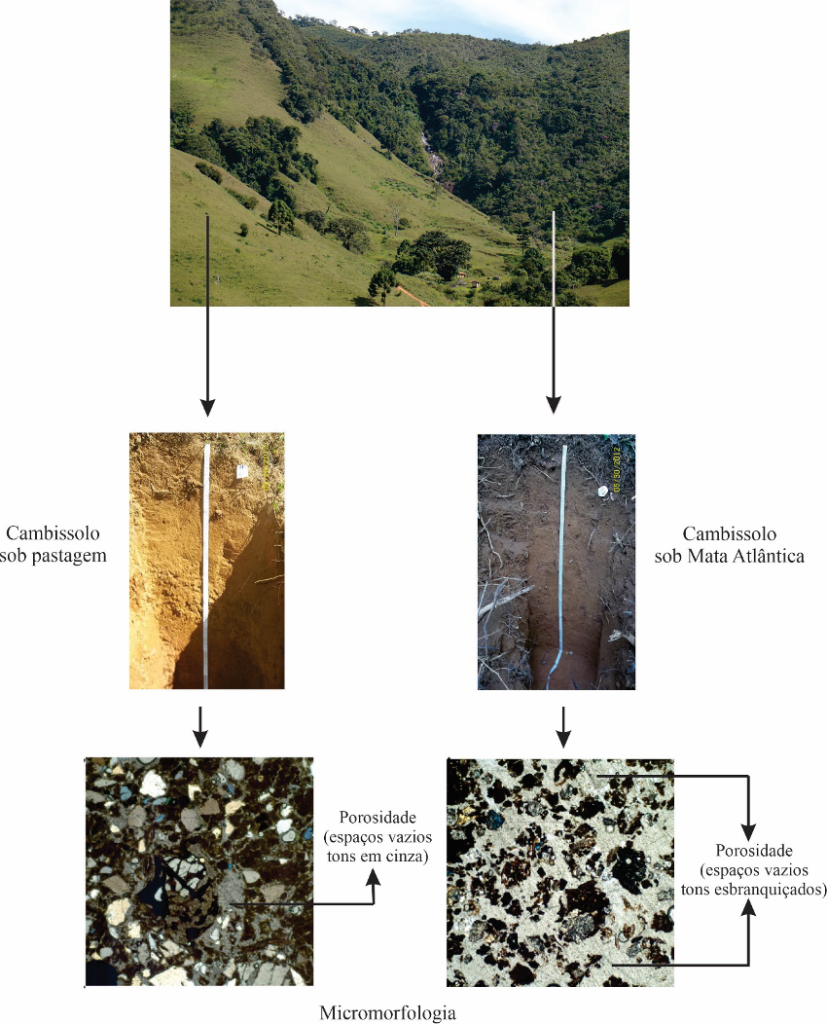
Figure 1. Images of a river basin in the Serra da Mantiqueira, with Cambisol profiles under Atlantic Forest and under pasture, and respective images from micromorphological analyses. Source: Pinto et al. (2015).
Soil structure and texture are attributes that potentially affect groundwater recharge. Structure refers to the arrangement, orientation and organization of solid soil particles, defining the geometry of their pore spaces (void spaces), while texture refers to the distribution of particles according to their size. The hydrological characteristics of a soil are greatly influenced by its structure in the form of preferential flows (or pathways) for both water movement and storage. In the superficial soil layers, wetting and drying cycles are responsible for reducing aggregate stability, affecting the structure that tends to behave as blocks, reducing void spaces (porosity). In soils such as Cambisols, their vulnerability to crusting (surface sealing) must also be considered, which drastically reduces water infiltration and significantly increases soil and water loss by erosion. In this context, maintaining vegetation cover becomes a fundamental aspect for achieving environmental sustainability in these soils.
Latosols are highly weathered, leached and deep soils, exhibiting physical (and hydrological) behavior that is normally superior to Argisols and Cambisols, in that order. This is due to the high aggregate stability of Latosols, which allows significant water flow through the soil profile. This causes most Latosols to exhibit hydrological behavior similar to a sandier soil, despite predominantly having clayey texture. In Latosols, structure tends to be more important than texture with regard to physical-hydraulic behavior (Resende et al., 2021).
Cambisols, in turn, generally behave in the opposite way to Latosols. The parent material is located closer to the surface (shallow soils), which favors rapid saturation and runoff formation, as well as reduced percolation (low hydraulic permeability) due to higher silt content relative to clay.
In this context, Argisols occupy an intermediate position between Latosols (more sustainable) and Cambisols (less sustainable).
Important Techniques Used by Hydropedology
In studies involving Hydropedology, the use of certain techniques, especially imaging and soil survey, becomes very important. Micromorphological analyses, the use of X-ray diffraction for mineral identification, soil mapping and its attributes in the field with the aid of computational techniques known as “Iwahashi and Pike” and “Geomorphons” are particularly noteworthy. Such techniques are very useful and, thanks to recent computational advances, are becoming relatively easy to apply and generate highly relevant products for hydrological studies in river basins. Figure 2 presents some examples of mappings based on the above-mentioned techniques in a river basin in the Serra da Mantiqueira. First, maps produced from field studies with Pedology are presented. Subsequently, topography maps and Hydropedology products that can be applied to watershed management, hydrological simulation and validation of the basin’s hydrological behavior are shown.
Future Perspectives
One of the main challenges of Hydropedology consists of evaluating techniques that allow for better identification of water flows in the soil profile. More advanced techniques such as tomography and the use of isotopes should allow advances toward a better understanding of hydrological processes in the soil and a greater theoretical-scientific basis about these fundamental phenomena for our existence.
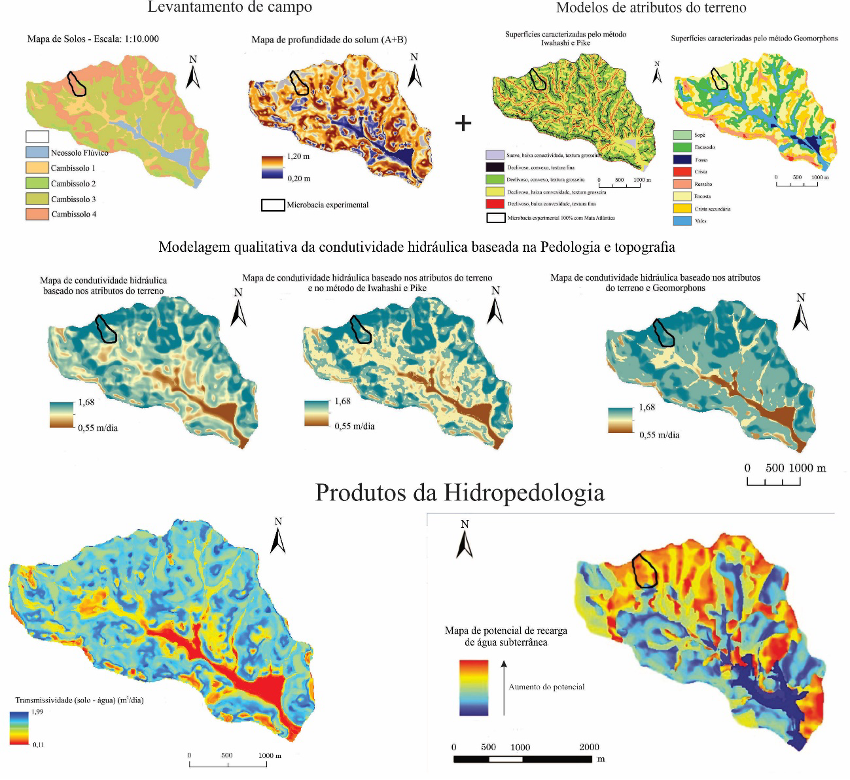
Figure 2. Illustration of Pedology applications as support for Hydrology in a headwater basin (Serra da Mantiqueira, MG). Source: Adapted from Pinto et al. (2015).
References
Ferreira MM, Fernandes B, Curi N. Clay fraction mineralogy and structure of Latosols from southeastern Brazil. Rev Bras Cienc Solo, 23:507-14, 1999. https://doi.org/10.1590/S0100-06831999000300003
Grunwald S. Environmental Soil-Landscape Modeling: Geographic Information Technologies and Pedometrics. 1st ed. New York: CRC Press; 2006.
Hartemink AE, Zhang Y, Bockheim JG, Curi N, Silva SHG, Grauer-Gray J, Lowe DJ, Krasilnikov P. Soil horizon variation: A review. Advances in Agronomy, 160:125-85, 2020. https://doi.org/10.1016/bs.agron.2019.10.003
Lin H. Hydropedology: Addressing Fundamentals and Building Bridges to Understand Complex Pedologic and Hydrologic Interactions. In: Lin H (Ed). Hydropedology: Synergistic Integration of Soil Science and Hydrology. Academic Press; 2012. p. 3-39.
Menezes MD, Silva SHG, Mello CR, Owens PR, Curi N. Solum depth spatial prediction comparing conventional with knowledge-based digital soil mapping approaches. Sci Agric. 71:316-23, 2014. https://doi.org/10.1590/0103-9016-2013-0416
Mello CR, Norton LD, Campos LC, Curi N. Hydropedology in the tropics. 1st ed. Lavras – MG: Editora UFLA; 2019.
Mello CR, Curi N. Hydropedology. Cienc Agrotec., 36:137-46, 2012. https://doi.org/10.1590/S1413-70542012000200001
Pinto LC, Zinn YL, Mello CR de, Owens PR, Norton LD, Curi N. Micromorphology and pedogenesis of mountainous Inceptisols in the Mantiqueira Range (MG). Cienc Agrotec., 39:455-62, 2015. https://doi.org/10.1590/S1413-70542015000500004
Silva SHG, Menezes MD de, Owens PR, Curi N. Retrieving pedologist’s mental model from existing soil map and comparing data mining tools for refining a larger area map under similar environmental conditions in Southeastern Brazil. Geoderma. 267:65-77, 2016. https://doi.org/10.1016/j.geoderma.2015.12.025
Resende M, Curi N, Poggere GC, Barbosa JZ, Pozza AAA, Teixeira AF dos S. Pedology, fertility, water and plant: Inter-relationships and applications. 2nd ed. Lavras – MG: Editora UFLA; 2021.
Resende M, Curi N, Rezende SB, Silva SHG. From rock to soil: Environmental approach. 1st ed. Lavras – MG: Editora UFLA; 2019.
Sobre os autores: 1Universidade Federal de Lavras, Escola de Engenharia, Departamento de Recursos Hídricos, Lavras, MG; 2Universidade Federal de Pelotas, Faculdade de Agronomia Eliseu Maciel, Departamento de Engenharia Rural, Pelotas, RS; 3Universidade Federal de Lavras, Escola de Ciências Agrárias, Departamento de Ciência do Solo, Lavras, MG.